
Book of Dead Slot: Engine Architecture and Mathematical Mechanics

Core Engine Rendering and HTML5 Infrastructure
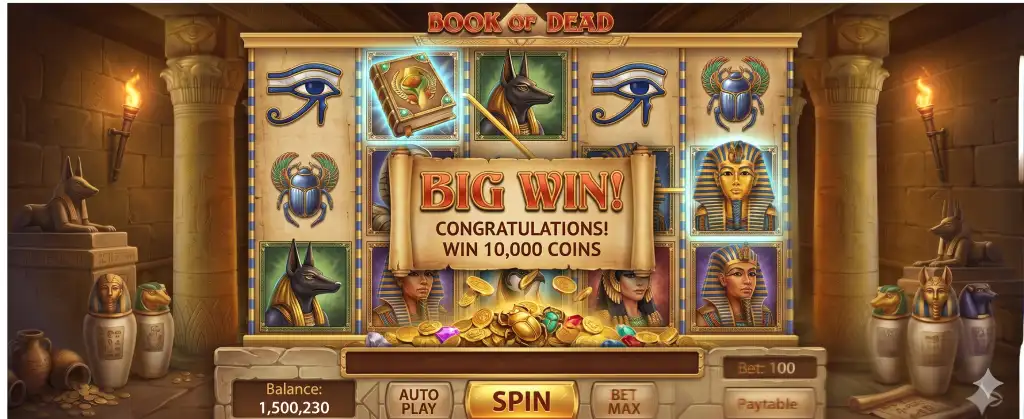
The Book of Dead slot operates on an advanced HTML5 framework, ensuring absolute structural parity across desktop and mobile processing units. Unlike legacy Flash-based systems, this modern deployment utilizes dynamic DOM (Document Object Model) scaling, which mathematically adjusts the 5×3 reel matrix and graphical assets based on the user terminal’s exact viewport dimensions.
The frame-rendering engine maintains a locked 60 FPS (frames per second) output on capable devices, preventing graphical tearing or latency spikes during high-speed spin sequences and expanding symbol animations.
Pseudorandom Number Generator (PRNG) Entropy
At the core of the slot’s mathematical matrix lies a highly calibrated PRNG algorithm. This system does not rely on simple internal chronometers; instead, it aggregates multiple environmental entropy sources to generate cryptographic seeds. These seeds are processed through a SHA-256 hashing algorithm millions of times per second.
When a user engages the “Spin” trigger, the exact microsecond of the request captures the active seed, immediately resolving the mathematical outcome of the 15 grid positions before the visual animation sequence even begins.
Client-Server Synchronization Protocols
Role of the User Terminal
The domestic user terminal (whether a smartphone or personal computer) functions strictly as a graphical interface client. The heavy computational load—calculating the 96.21% RTP deviation paths, volatility spikes, and payline evaluations—occurs entirely on the centralized secure server nodes.
Data Exchange and Protection
The client sends a lightweight execution request, and the server returns an encrypted data packet containing the visual coordinates and financial resolution. This isolated architecture completely neutralizes any localized software modification, memory injection attempts, or client-side prediction algorithms.
| Technical Component | Execution Zone |
|---|---|
| Graphics and animation rendering (60 FPS) | Client Terminal |
| PRNG seed generation and SHA-256 hashing | Server Node |
| RTP deviation and volatility calculation | Server Node |
| Payline evaluation and financial resolution | Server Node |
| Encrypted coordinate packet transmission | Client-Server Channel |